

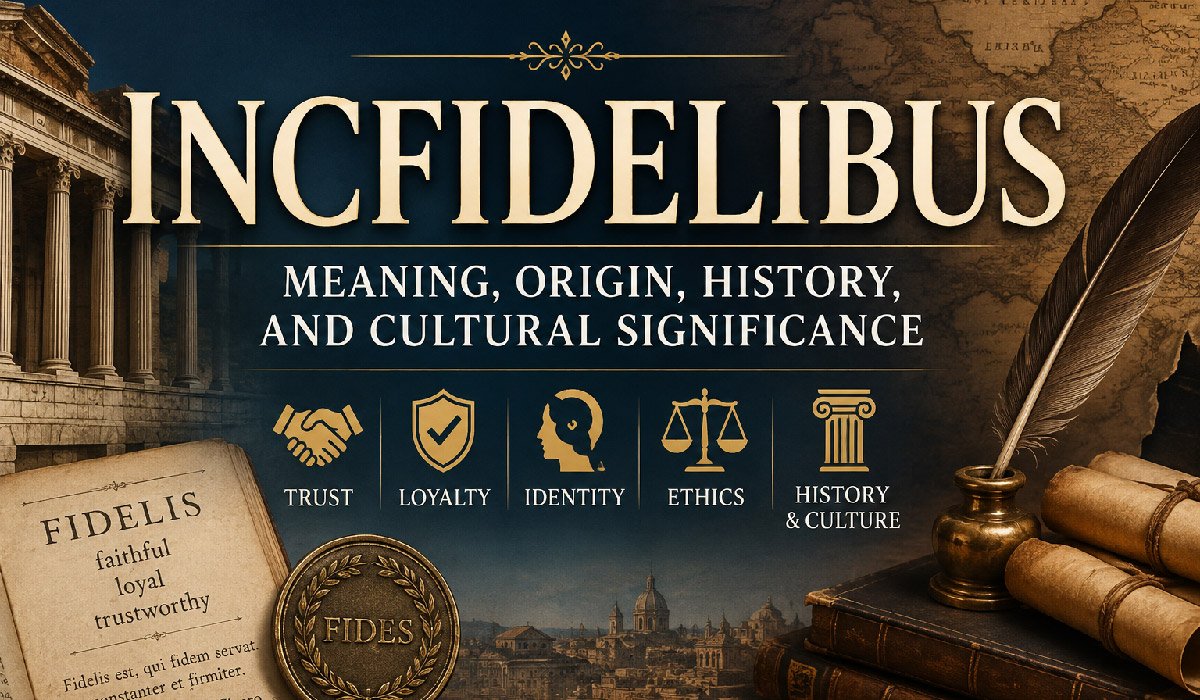
Incfidelibus is an unusual term connected with ideas of trust, loyalty, identity, and human responsibility. Its Latin-like form has also created interest among people who enjoy exploring language, history, philosophy, and cultural concepts.
The keyword has gained attention because its meaning is not immediately clear. People searching for Incfidelibus often want to understand its origin, possible Latin connection, historical background, and the ideas represented by the term.
This guide explores Incfidelibus in simple detail. It covers its meaning, linguistic roots, historical connections, philosophical importance, cultural role, creative uses, and modern relevance while helping readers understand why the term attracts attention today.
What Is Incfidelibus?
Incfidelibus is generally used as a term connected with trust, faithfulness, loyalty, identity, and moral responsibility. Instead of describing a particular person, object, or place, it represents a wider group of ideas about values and relationships.
The word has a structure that strongly resembles Latin. Its connection with terms related to faith and loyalty has led to interpretations involving human behavior, personal beliefs, responsibility, and the way people build dependable relationships with others.
For this reason, Incfidelibus is best understood through its wider meaning rather than through a single definition. Language, philosophy, ethics, and cultural history all provide useful ways of understanding the ideas associated with the term.
Why Is Incfidelibus Gaining Attention?
One reason Incfidelibus attracts attention is its unusual spelling. It looks like an old or specialized word, encouraging readers to search for its definition and discover whether it comes from Latin or another historical language.
Its meaning also creates curiosity. Trust, loyalty, honesty, and identity are familiar subjects, but connecting these ideas with an uncommon term makes people interested in learning how language can represent deeper questions about human behavior.
Online discussions have further increased interest in the keyword. Readers encounter different explanations and naturally want a simple guide that brings its linguistic, historical, cultural, and philosophical associations together in an understandable way.
The Meaning Behind Incfidelibus
The meaning associated with Incfidelibus mainly centers on faithfulness, loyalty, trust, identity, and responsibility. These ideas describe qualities that influence how individuals communicate, form relationships, make decisions, and behave within larger communities.
Trust means being able to depend on another person. Loyalty involves commitment to people, principles, or responsibilities. Faithfulness is closely related because it represents consistency and reliability in relationships, beliefs, and personal promises.
In a broader sense, Incfidelibus can therefore be understood as a concept for examining these connected values. Its meaning becomes especially useful when discussing relationships, ethics, identity, personal responsibility, and the expectations people place on one another.
Where Does the Word Incfidelibus Come From?
The form of Incfidelibus points toward Latin-style word construction. Latin has influenced English and many European languages, so unfamiliar words containing recognizable Latin elements often attract interest from people researching their possible origins.
An important element in understanding the term is its resemblance to fidelis. In Latin, fidelis carries meanings associated with being faithful, loyal, trustworthy, or dependable. Related forms have influenced several words used in modern languages.
The beginning of Incfidelibus also resembles the Latin prefix “in-.” That prefix can perform different functions depending on the word and grammatical setting. Together, these similarities help explain why Incfidelibus is frequently interpreted through Latin language patterns.
Incfidelibus and Its Latin Connection
Latin provides useful background for understanding Incfidelibus because the term closely resembles words formed around faith and faithfulness. The Latin fidelis is particularly important when examining why loyalty and trust appear so often in its meaning.
Modern English contains several words influenced by the same linguistic family. Fidelity, for example, refers to faithfulness or loyalty. Such connections demonstrate how older language roots can survive and develop new forms or meanings across different periods.
Incfidelibus can therefore be explored as a Latin-influenced expression associated with faithfulness and its surrounding ideas. Understanding this linguistic relationship makes its connections with loyalty, trust, personal beliefs, and responsibility easier for modern readers to recognize.
Trust and Loyalty Behind the Concept
Trust is one of the strongest ideas associated with Incfidelibus. People depend on trust in friendships, families, workplaces, communities, and institutions. It allows individuals to cooperate because they believe others will behave honestly and responsibly.
Loyalty adds another dimension. A loyal person remains committed to someone, something, or a principle. However, loyalty can also create difficult moral questions when personal commitment conflicts with fairness, honesty, or another important responsibility.
These questions give Incfidelibus greater philosophical depth. The concept can encourage people to consider what makes someone trustworthy, when loyalty is valuable, and how individuals should respond when different responsibilities or personal values come into conflict.
Historical Ideas Connected With Incfidelibus
Faith, loyalty, and responsibility were important subjects throughout European intellectual history. During the Middle Ages, religious belief and social duties strongly influenced discussions about morality, personal behavior, authority, relationships, and responsibilities within communities.
The Renaissance brought renewed interest in ancient Greek and Roman literature, philosophy, and languages. Scholars examined older ideas about human nature, civic responsibility, virtue, education, and morality while developing new ways of thinking about individuals and society.
The Enlightenment later placed greater emphasis on reason, individual freedom, and ethical thinking. Questions concerning responsibility, justice, cooperation, and human behavior became increasingly important, creating historical settings in which themes associated with Incfidelibus can be meaningfully explored.
Incfidelibus in Philosophy and Ethics
Philosophy asks important questions about how people should live and behave. Trust and loyalty fit naturally into these discussions because human relationships depend on decisions about honesty, commitment, fairness, responsibility, and respect for others.
Ethics examines what people consider right or wrong. A person may sometimes need to choose between loyalty to another individual and responsibility toward a wider group. Such situations show why loyalty cannot always be understood as a simple obligation.
Incfidelibus offers a useful framework for considering these questions. Its associated themes encourage reflection on personal values, ethical choices, commitments, and the consequences that individual decisions can have for relationships and communities.
Its Connection With Identity and Human Relationships
Identity develops through many influences, including family, culture, personal experiences, beliefs, education, and social relationships. People often define themselves partly through the values they follow and the communities or individuals they feel connected to.
Trust and loyalty can strongly influence these connections. Reliable relationships help people develop confidence and belonging, while dishonesty or broken commitments can change how individuals view themselves, other people, and their place within a community.
The ideas associated with Incfidelibus therefore extend beyond language. They provide a way of considering how trust, commitment, personal values, and responsibility contribute to identity and shape the relationships people develop throughout their lives.
Cultural Importance of Incfidelibus
Cultures do not always define loyalty and responsibility in exactly the same way. Family traditions, religious beliefs, social expectations, laws, and historical experiences can influence what people consider trustworthy, faithful, respectful, or morally responsible behavior.
Despite these differences, trust remains important across societies. Communities function more effectively when individuals can depend on agreements, promises, institutions, and one another. This makes reliability more than simply a personal characteristic.
Incfidelibus becomes culturally interesting because its central themes can be examined across different societies and historical periods. It encourages readers to consider both universal human values and the different ways cultures understand commitment, identity, and responsibility.
Incfidelibus in Literature and Creative Expression
Literature regularly explores loyalty, betrayal, identity, trust, and moral choices. Characters may have to choose between family and personal beliefs, friendship and duty, or individual interests and responsibilities toward a larger community.
Similar ideas appear in theatre and film. Stories become engaging when characters face difficult choices with meaningful consequences. Questions about whom to trust, whether to remain loyal, and how to respond to betrayal can create powerful emotional conflicts.
Visual art and music can express these themes differently through symbols, contrast, emotion, and personal interpretation. This makes the ideas associated with Incfidelibus relevant to creative expression even when the specific word itself does not appear.
Why Incfidelibus Still Matters Today
Modern society still depends heavily on trust. People expect honesty from friends, family members, employers, businesses, institutions, and leaders. When trust exists, relationships and cooperation usually become easier to maintain over long periods.
Responsibility is equally important. Individuals regularly make choices that affect other people. Keeping promises, communicating truthfully, respecting commitments, and accepting responsibility for decisions are practical examples of values closely related to the themes surrounding Incfidelibus.
Technology has changed how people communicate, but it has not removed these basic questions. Online relationships, digital communities, businesses, and institutions still depend on credibility, honesty, accountability, and confidence between people.
Incfidelibus in Education and Academic Study
Language students can use terms such as Incfidelibus to examine how words are formed and interpreted. Looking at possible roots and related vocabulary can demonstrate how older languages continue to influence modern expressions and ideas.
Philosophy and cultural studies provide another perspective. Students can explore loyalty, responsibility, identity, morality, and trust while comparing how these ideas have been understood by different societies and during different historical periods.
Libraries, universities, historical collections, and digital archives also make language research easier. Access to older texts allows researchers to compare vocabulary and trace linguistic development while studying how philosophical and cultural ideas changed over time.
How the Idea Applies to Modern Life
The principles associated with Incfidelibus can be seen clearly in everyday relationships. Friendships and families often become stronger when people communicate openly, respect one another, remain dependable, and take responsibility for their actions.
The same principles apply professionally. Employers depend on workers to complete responsibilities, while employees expect fair treatment and clear communication. Businesses also need customer trust, particularly when handling payments, personal information, products, and services.
Public life provides another example. Communities and institutions depend on cooperation and accountability. Although circumstances change across different settings, trust, honesty, commitment, and responsible behavior continue to influence how effectively people work together.
Why People Continue to Search for Incfidelibus
The biggest reason people search for Incfidelibus is curiosity about its meaning. Its unfamiliar spelling immediately raises questions about whether it belongs to Latin, philosophy, history, literature, or another specialized area of study.
Its broad interpretation creates further interest. Someone researching Latin may focus on its linguistic structure, while another reader may be more interested in its connections with trust, loyalty, ethics, identity, and relationships.
Ultimately, Incfidelibus attracts attention because an unusual word leads to familiar human questions. Understanding its linguistic associations and wider themes helps explain why the keyword continues to appear in discussions involving language, culture, philosophy, and human values.
Final Thoughts
Incfidelibus is best understood as a Latin-influenced term associated with trust, loyalty, faithfulness, identity, and moral responsibility. Its connection with fidelis provides an important clue for understanding why these themes are closely linked with the word.
Its importance extends beyond language. Trust, commitment, responsibility, and identity have influenced philosophical thought, cultural traditions, literature, relationships, education, business, and community life throughout different periods of human history.
For modern readers, Incfidelibus provides an interesting starting point for exploring these ideas together. Its unusual linguistic form attracts attention, while the familiar questions surrounding honesty, loyalty, identity, and responsibility give the concept lasting relevance.
FAQs
What does Incfidelibus mean?
Incfidelibus is commonly associated with trust, loyalty, faithfulness, identity, and moral responsibility. It can be understood as a concept for exploring how these values influence human relationships, ethical choices, culture, and personal behavior.
Is Incfidelibus a Latin word?
Incfidelibus has a strong Latin-like structure and is commonly connected with Latin linguistic elements. Its resemblance to fidelis, meaning faithful, loyal, or trustworthy, is particularly important when explaining the ideas associated with the term.
What is the origin of Incfidelibus?
The origin of Incfidelibus is generally explored through its Latin-style construction. Its most noticeable linguistic connection is with fidelis, a Latin term associated with faithfulness, loyalty, reliability, and trustworthiness.
Why is Incfidelibus important?
Incfidelibus is interesting because it brings together important ideas about loyalty, trust, identity, responsibility, and ethics. These themes influence personal relationships, cultural values, education, leadership, business, and wider discussions about human behavior.
Why do people search for Incfidelibus?
People mainly search for Incfidelibus because they encounter the unusual term and want to understand its meaning and origin. Its Latin appearance and connections with philosophy, loyalty, trust, identity, and culture create additional curiosity.
Latest News And Amazing News. Visit: Insider Zine