

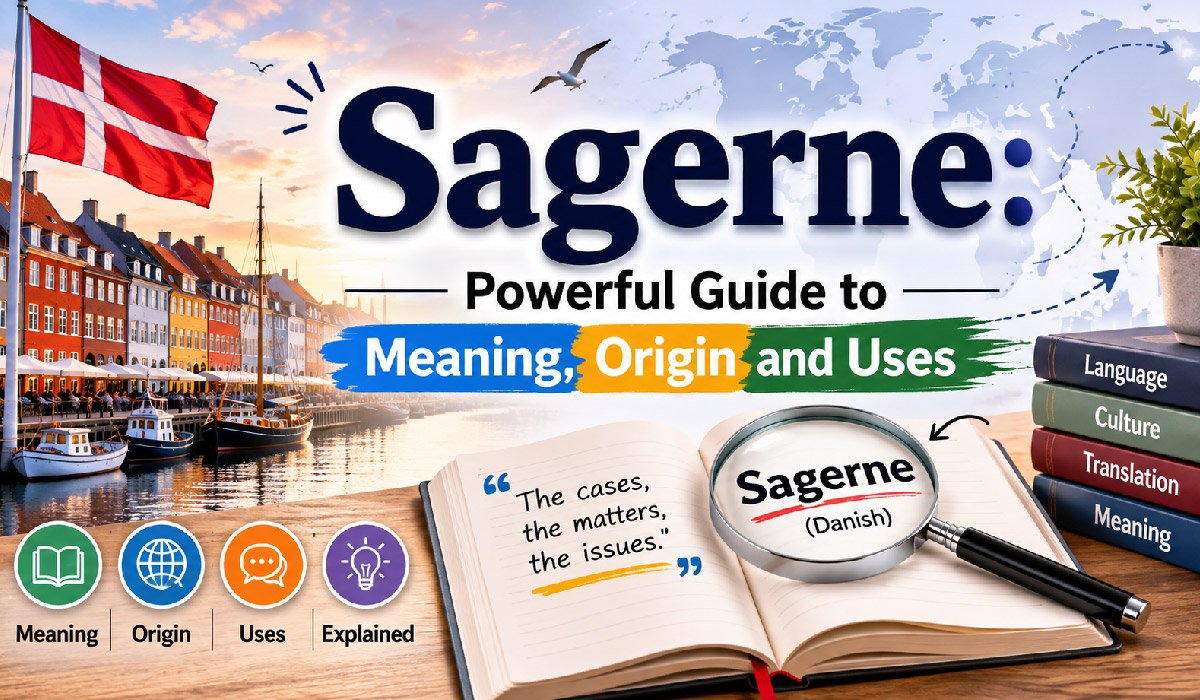
Sagerne is a Danish word that can have different English translations depending on the situation in which it appears. People may encounter Sagerne in Danish articles, online conversations, search results, social media posts, or names used for digital projects. Because the word is unfamiliar to many English speakers, it can easily be mistaken for the name of a company, platform, movement, or internet trend.
The clearest way to understand Sagerne is to begin with its linguistic meaning. It comes from Danish, where it is related to the noun “sag,” a word that can mean a case, matter, issue, or affair. Its exact translation changes according to context.
At the same time, words can develop additional associations when they travel online. This article explains Sagerne meaning, Danish origin, language structure, pronunciation, everyday uses, online interpretations, branding possibilities, and common misunderstandings in simple detail.
What Is Sagerne?
Sagerne is primarily a Danish word. In simple English, it can often be understood as “the cases,” “the matters,” or sometimes “the issues.” However, there is no single English translation that works perfectly in every sentence. The surrounding subject determines which meaning makes the most sense.
For example, a Danish news report discussing several legal cases may use Sagerne in a way that is best translated as “the cases.” In another discussion involving political or public matters, “the matters” or “the issues” could provide a more natural English meaning. This contextual difference is important.
Outside Danish-language communication, Sagerne can look like a proper name because it is unfamiliar to international readers. It might therefore be interpreted as a project, username, brand, or community label. These uses should be separated from the established Danish meaning of the word.
Sagerne Meaning in Danish
To understand Sagerne meaning properly, it helps to look at the Danish noun “sag.” Sag has several related meanings rather than one narrow definition. Depending on the sentence, it may describe a case, matter, affair, cause, issue, or subject being considered. The plural and definite forms change its grammatical role.
Sagerne generally refers to particular cases or matters rather than cases in an indefinite sense. An English translator must therefore examine what the writer is discussing. If the subject involves courts, “the cases” could be appropriate. If people are discussing business or public affairs, another translation may sound better.
This is why automatic translation without context can sometimes create confusion. Language is not simply a process of replacing every foreign word with one English word. Understanding Sagerne requires both its grammatical meaning and the topic surrounding it.
The Linguistic Structure of Sagerne
The structure of Sagerne becomes easier to understand when it is viewed as part of Danish grammar. The basic noun is sag. Its plural form is sager, while sagerne is the definite plural form. In very simple terms, this progression can be understood as moving from “a case or matter” toward “cases or matters” and finally “the cases or matters.”
Danish commonly expresses definiteness through endings attached to nouns. This is different from English, where speakers normally place a separate word such as “the” before a noun. That grammatical difference explains why the ending of Sagerne carries important information.
Understanding this structure also prevents a common mistake. Sagerne is not simply an invented collection of letters created for social media. It has a real grammatical role in Danish. Any newer branding or digital interpretation exists separately from that established linguistic foundation.
Origin and Etymology of Sagerne
Sagerne belongs to Danish, a North Germanic language closely related to Norwegian and Swedish. Its linguistic background therefore reaches much further back than modern websites, hashtags, or online communities. The word is built from an established Danish noun and normal grammatical patterns rather than originating as recent internet slang.
The base word “sag” has long been associated with ideas such as a matter, affair, issue, cause, or case. Over time, grammatical forms developed according to the structure of Danish. Sagerne consequently has an ordinary language function that should be considered before attaching modern interpretations to it.
This distinction matters when discussing Sagerne origin. A website or online community may adopt an existing word and give it a special identity, but that does not rewrite its linguistic history. Its Danish foundation and any later digital usage should therefore be explained separately for accuracy.
How to Pronounce Sagerne
Sagerne pronunciation may be difficult for English speakers because Danish contains sounds and speech patterns that do not always have direct English equivalents. Reading the word exactly as if it were English can therefore produce a pronunciation quite different from how a native Danish speaker would naturally say it.
The important point is that the written letters should not automatically be assigned English sounds. Danish pronunciation often involves softened consonants, reduced vowel sounds, and endings that may sound less strongly pronounced than their spelling suggests. Regional speech and speaking speed can also influence what listeners hear.
For learners, listening to a reliable Danish dictionary recording or native speaker is more useful than relying completely on an English phonetic approximation. Understanding the spelling is still valuable, but hearing the word provides a clearer idea of its natural rhythm and pronunciation within a complete Danish sentence.
How Sagerne Is Used in Everyday Danish
Sagerne can appear naturally whenever Danish speakers discuss multiple specific matters, cases, affairs, or issues. The precise English translation depends on the subject. Someone discussing court proceedings, for example, might use the word in connection with particular cases. A different conversation could involve matters being reviewed by an organization or public body.
The word can also occur in ordinary discussions where several known subjects have already been introduced. Because Sagerne is definite, the listener or reader generally understands which matters or cases are being referenced. Context supplies information that a direct dictionary translation cannot always communicate completely.
This everyday use is important because online explanations sometimes make ordinary foreign words appear mysterious. For Danish speakers, Sagerne does not need to represent a special philosophy or digital idea. It can simply perform its normal grammatical function within a sentence, just as familiar nouns do in English.
Sagerne in Legal, Political, and News Contexts
News and public affairs provide useful examples of how Sagerne can change meaning according to context. In reporting about courts, investigations, or disputes, translating it as “the cases” may be suitable. When an article discusses broader public questions or ongoing affairs, “the matters” or “the issues” might communicate the intended meaning more naturally.
Political reporting creates similar variation. Journalists may refer to several known matters that politicians, institutions, or officials are considering. A reader translating only Sagerne without looking at the surrounding sentences may miss important information about what kind of matters the article actually describes.
For this reason, anyone who encounters Sagerne in Danish journalism should examine the complete sentence before choosing an English meaning. Translation tools can provide a starting point, but subject matter remains essential. Legal, political, business, and general contexts can all influence the most suitable English wording.
Why Sagerne Can Confuse English Speakers
Sagerne can appear unusual to an English-speaking reader because its grammatical ending is not immediately recognizable. Without knowing Danish, someone may assume that the capitalized version is the name of a website, technology company, application, cultural group, or new internet concept. Search results containing different explanations can increase that uncertainty.
Another source of confusion is the way unfamiliar words spread online. A term can be copied from one page to another without its original context. Writers may then build new explanations around it, making an ordinary word seem like a newly created trend. Capitalization can strengthen this impression even though capitalization alone does not establish a separate meaning.
The best solution is to identify where the word appears. If Sagerne occurs naturally inside Danish text, its ordinary linguistic meaning is usually the strongest starting point. A logo, username, product name, or website requires separate investigation.
Sagerne and Modern Online Interpretations
The internet allows words to travel far beyond the languages in which they originated. Sagerne can therefore appear in English-language search results, social posts, usernames, article titles, or creative projects even when the surrounding audience does not speak Danish. In these settings, users may attach additional meanings to the word.
This process is common in digital culture. People often select foreign words because they like their appearance, sound, cultural association, or unusual spelling. Once adopted by a community, a word may become a label for content that has little connection with its dictionary definition. Repeated use can then create a secondary online association.
However, an online interpretation should not automatically replace Sagerne’s established Danish meaning. Readers should distinguish between documented language usage and meanings created by individual websites or communities. Both may exist in a particular context, but they represent different forms of usage and require different evidence.
Is Sagerne Really a Digital Trend or Movement?
Some online descriptions may present Sagerne as a digital trend, cultural idea, or community-driven movement. Such claims should be treated carefully unless there is clear evidence showing widespread and sustained adoption. A few articles or social posts using the same word do not automatically establish an organized movement.
A genuine digital trend normally leaves visible signs. People repeatedly use the term across communities, discussions develop around a recognizable idea, and participation continues beyond isolated mentions. An organized movement would generally require even stronger evidence, such as identifiable goals, communities, leadership, campaigns, events, or documented collective activity.
Therefore, describing Sagerne as an established movement without supporting evidence can create unnecessary confusion. It is more accurate to say that the word can receive new interpretations online. Those interpretations may develop further, but they remain separate from the established Danish language meaning unless a particular community clearly defines its own usage.
Is Sagerne a Website, App, Company, or Brand?
A word can be both ordinary vocabulary and a commercial name. Businesses regularly select existing words for products, websites, applications, and companies because recognizable language can create a memorable identity. Therefore, seeing Sagerne used as a name does not necessarily mean that its Danish definition has changed.
Readers should examine the specific source before deciding what Sagerne represents. If the term appears beside a company logo, application description, domain name, or product page, it could be functioning as a proper name in that situation. The organization would then need to be evaluated independently rather than through the dictionary meaning alone.
It is also important not to assume that every search result refers to one central Sagerne platform. Different people or projects can independently use the same existing word. The Danish linguistic meaning should therefore remain distinct from any commercial service that adopts Sagerne as its identity.
Why Sagerne Has Branding Potential
From a branding perspective, Sagerne has several characteristics that could attract creators or businesses. It is relatively compact, visually distinctive for many international audiences, and connected with Scandinavian language. Someone unfamiliar with Danish may also become curious about the name, which can make it memorable when used thoughtfully.
Its original meaning could work especially well for projects involving cases, discussions, public affairs, stories, or organized subjects. However, businesses are not required to preserve a word’s dictionary meaning when creating a brand. Many brand names develop identities that differ significantly from their original linguistic definitions.
Brand potential should not be confused with proof that a major Sagerne company already exists. These are separate questions. Saying that a word could work as a brand is an observation about naming possibilities. Claiming that it represents an established platform requires evidence about a specific company, product, website, or organization.
Common Misunderstandings About Sagerne
One common misunderstanding is that Sagerne must have one exact English definition. In reality, words such as case, matter, issue, or affair may become appropriate depending on context. Translation requires understanding the complete sentence rather than selecting one English equivalent and applying it everywhere.
Another misconception is that Sagerne is automatically a newly invented digital term because English-speaking users may discover it through search engines or social media. Its Danish linguistic use predates modern online interpretations. Similarly, there is no reason to describe it as an ancient cultural ceremony, modern philosophy, or organized community unless reliable evidence supports that specific claim.
Readers should also avoid assuming every occurrence refers to the same thing. Sagerne inside a Danish sentence and Sagerne displayed as a brand name may have very different functions. Separating language, branding, and internet usage provides a much clearer explanation.
How to Understand Sagerne Based on Context
Context provides the easiest method for determining what Sagerne means in a particular situation. First, consider the language surrounding the word. If the complete sentence is Danish and discusses several known cases or matters, Sagerne is probably performing its normal grammatical role. The subject then helps determine the best English translation.
Next, examine how the word is presented. If it appears prominently as a logo, username, hashtag, website title, or product name, it may be functioning as a unique identifier. In that case, translating it literally might not explain what the creator intends the name to represent.
Finally, consider the reliability of the source. A dictionary, established language resource, company page, and anonymous social post provide different types of evidence. Checking context before accepting an interpretation prevents an ordinary Danish term from being incorrectly presented as something entirely different.
Sagerne and the Evolution of Words Online
Sagerne provides a useful example of how language can move through the modern internet. Search engines and social platforms expose people to words from languages they may never have studied. Users can then repeat those words, turn them into hashtags, choose them as usernames, or attach creative ideas to them.
As usage spreads, a distinction can develop between the original linguistic meaning and a newer digital meaning. This does not necessarily make the newer interpretation wrong. Communities have always influenced language. However, a secondary meaning becomes meaningful only when people actually use and understand it consistently within a recognizable context.
The internet makes this evolution much faster and more visible. A term can cross borders within hours, while its background may be lost along the way. Understanding Sagerne therefore shows why checking linguistic origins remains important even when a word appears to have developed a modern online identity.
Why Context Matters More Than a Single Definition
Searching “what does Sagerne mean?” may seem like a question that deserves one short answer, but context provides a more accurate explanation. In Danish, it commonly points toward specific cases, matters, or related subjects. The exact English wording changes according to what those subjects are and how the sentence is constructed.
Digital environments add another layer. The same spelling can be used intentionally as the name of a project, account, website, creative concept, or business. In such situations, the creator may give Sagerne a specialized meaning that does not follow its literal Danish translation. That specialized use applies to the particular context rather than automatically becoming a universal definition.
Readers should therefore avoid treating every search result as evidence of one meaning. Language context, source quality, and intended usage together provide the clearest way to understand what Sagerne represents.
Future Use of Sagerne in Digital Culture
The future of Sagerne online will depend on how people actually use the word. Its established role in Danish can continue independently of any international digital attention. At the same time, creators, communities, and businesses may adopt the term for projects because its spelling and Scandinavian connection provide a distinctive identity.
If a specific digital interpretation becomes widely used, Sagerne could develop an additional meaning within that community. Language often evolves this way. However, lasting new meanings normally require repeated and recognizable usage rather than temporary curiosity generated by a small number of posts or articles.
For that reason, predictions about Sagerne becoming a major global trend should remain cautious. Its linguistic meaning is established, while its wider digital identity is more dependent on context. Future platforms, communities, or brands could influence how international audiences understand the term, but usage will determine that development.
Final Thoughts
Sagerne is best understood first through its Danish linguistic foundation. It is related to “sag” and can refer to specific cases, matters, issues, or affairs depending on context. Understanding its grammatical structure makes the word much less mysterious and explains why a single English translation cannot capture every possible use.
The internet creates additional possibilities. Sagerne may appear as a name, hashtag, project identity, brand, or creative label outside ordinary Danish communication. These newer applications can be valid within their own settings, but they should not be confused with the established meaning of the Danish word.
Ultimately, context is the key to understanding Sagerne. Readers should consider the language, surrounding sentence, source, and way the term is presented. Doing so provides a clearer distinction between Sagerne as ordinary Danish vocabulary and any newer meaning created through branding or digital culture.
FAQs
What does Sagerne mean?
Sagerne is a Danish word that can mean “the cases,” “the matters,” or “the issues” in English. The most accurate translation depends on the sentence, subject, and situation in which the word is being used.
Is Sagerne a Danish word?
Yes, Sagerne is a Danish word. It comes from “sag,” which can mean a case, matter, issue, or affair. “Sagerne” is a definite plural form and generally refers to particular cases or matters.
How is Sagerne used in Danish?
Sagerne can appear in everyday conversations, news reports, political discussions, legal contexts, and other Danish writing. Its English translation changes according to the subject being discussed, so understanding the surrounding sentence is important.
Is Sagerne an online trend or movement?
Sagerne may appear in online discussions and can be given new meanings by websites or communities. However, its established meaning comes from Danish. Claims that it represents a specific online movement should be supported by clear evidence.
Can Sagerne be used as a brand or platform name?
Yes. Like many existing words, Sagerne could be adopted as the name of a website, company, app, community, or digital project. A branded use should be distinguished from the word’s original Danish linguistic meaning.
Latest News And Amazing News. Visit: Insider Zine