

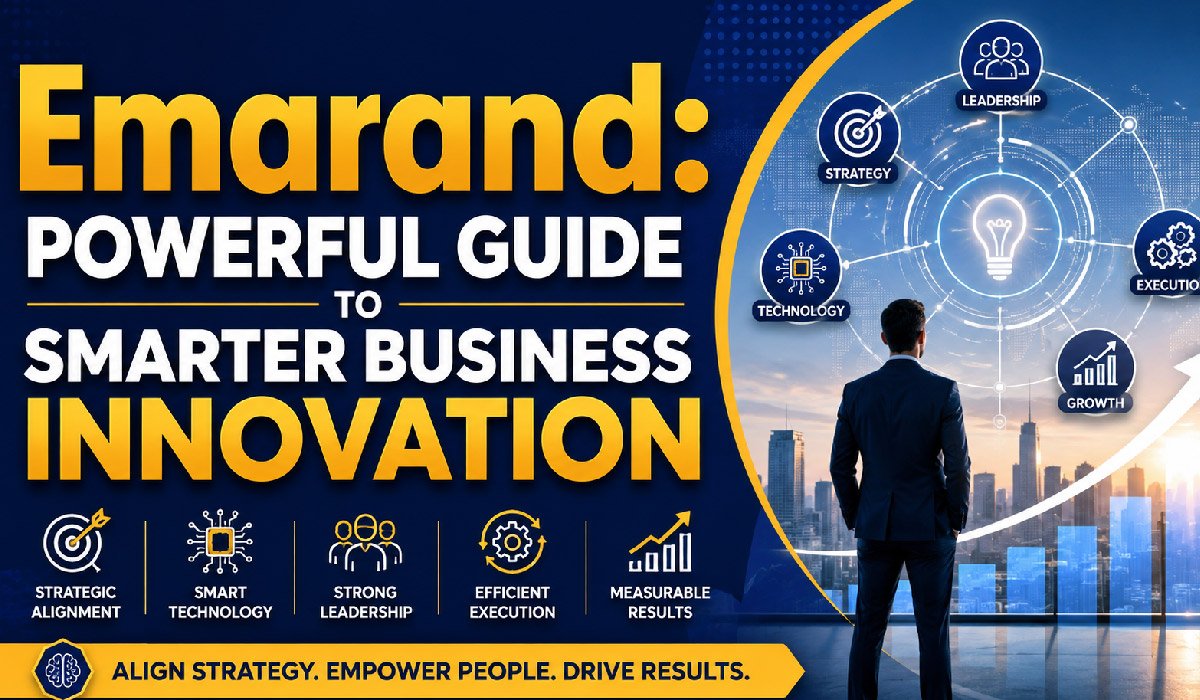
Emarand can be understood as a strategic innovation concept that connects technology, leadership, planning, and execution with clear business goals. Instead of adopting every new digital tool, the approach focuses on choosing solutions that solve real problems. This makes innovation more purposeful and easier to manage.
Modern organizations often use many software tools, automation systems, data platforms, and communication channels. However, adding more technology does not automatically improve performance. Poorly connected systems can increase costs, create confusion, and make teamwork more difficult. Emarand focuses on bringing these different areas together around shared objectives.
The idea is especially relevant in a business environment shaped by artificial intelligence, automation, remote work, and fast digital change. This article explains Emarand, its meaning, principles, practical applications, leadership role, technology connection, benefits, challenges, measurement methods, and possible future development.
What Is Emarand?
Emarand is best described in this context as a strategic innovation philosophy rather than a specific software product or fixed technical system. Its central idea is simple: innovation should support a meaningful goal. Technology, people, processes, and leadership decisions should work together instead of operating as separate parts of an organization.
Under this approach, a company does not introduce a new system simply because it is popular. Leaders first identify the business problem and decide what result they want. They can then examine whether technology, process changes, employee training, or another solution can help achieve that result.
Emarand therefore places purpose before tools. It encourages businesses to connect innovation with measurable outcomes such as better customer experiences, lower operating costs, faster processes, stronger productivity, or sustainable revenue growth. The exact application can vary because every organization has different needs, resources, and priorities.
What Does Emarand Mean in Business?
In a business setting, Emarand represents alignment between strategy and action. A company may have ambitious plans, skilled employees, and advanced technology, but these resources provide limited value when they move in different directions. Strategic alignment helps ensure that daily work supports larger organizational objectives.
For example, a business may invest in customer relationship software to improve customer retention. Under an Emarand-style approach, buying the software would only be one part of the process. The company would also examine employee responsibilities, existing workflows, customer needs, training requirements, data quality, and the measurements used to evaluate improvement.
This makes Emarand broader than technology adoption alone. It encourages organizations to ask why an initiative is necessary, how it supports the strategy, who will manage it, and how success will be measured. These questions can turn general innovation goals into practical business actions.
Why Emarand Is Relevant to Modern Organizations
Businesses now operate in an environment where new technologies appear quickly. Artificial intelligence, cloud platforms, automation, analytics, and digital collaboration tools can create valuable opportunities. At the same time, adopting too many systems without a clear plan can create duplication, higher costs, security concerns, and complicated workflows.
Emarand addresses this problem by encouraging selective and purposeful innovation. Rather than measuring progress by the number of new technologies introduced, organizations can examine whether those technologies improve meaningful outcomes. This approach can be particularly useful when budgets, employees, and management attention are limited.
Strategic clarity also becomes more important as companies grow. A small team may communicate informally, but larger organizations usually require clearer processes and responsibilities. Emarand provides a way to think about growth without separating technology from people, leadership, operations, and performance. Its value comes from coordination rather than constant technological change.
Origins and Development of the Emarand Concept
Emarand does not appear in the information provided as a long-established academic management theory with a clearly documented historical founder or formal origin. It is therefore safer to understand it as an emerging strategic concept associated with problems created by fragmented digital transformation rather than assigning it an unsupported history.
Those problems are easy to recognize in modern organizations. Companies can gradually accumulate software subscriptions, dashboards, automation tools, communication platforms, and separate databases. Individual departments may choose solutions independently, creating systems that perform useful tasks but do not communicate effectively with one another.
The Emarand concept responds to this type of fragmentation by emphasizing integration and alignment. Its development can be understood through the wider movement toward outcome-focused digital transformation. Instead of treating innovation as constant disruption, it favors deliberate decisions, connected systems, shared goals, and measurable value. This distinction is important when explaining the concept accurately.
Core Principles Behind Emarand
Strategic alignment is one of the central ideas behind Emarand. Every important initiative should have a clear connection with an organizational objective. A technology investment, for example, should improve a defined area of performance rather than simply add another tool to the company’s digital environment.
Integration is equally important. Employees, departments, data, processes, and technologies need to work together. A technically advanced system can still produce disappointing results when employees do not understand it or when it conflicts with existing workflows. Emarand therefore treats human and operational factors as important parts of innovation.
Another principle is disciplined execution. Good ideas create little value when organizations fail to implement them properly. Emarand combines planning with measurement, accountability, collaboration, and review. It also encourages sustainable progress rather than temporary results. Together, these principles create an approach in which innovation is judged by useful outcomes rather than novelty alone.
How the Emarand Framework Works in Practice
Applying Emarand begins with understanding the current situation. An organization can examine its objectives, systems, workflows, technology costs, employee responsibilities, customer needs, and operational problems. This diagnostic stage helps leaders identify gaps before spending money or changing established processes.
The next stage connects identified problems with strategic priorities. Teams determine which issues deserve attention and define the results they expect. Existing systems can then be improved, integrated, replaced, or removed where appropriate. New technology should be considered only when it provides a clear advantage over available solutions.
Execution follows planning. Responsibilities need to be clear, teams need access to relevant information, and progress needs to be measured against defined goals. Results should then guide further decisions. If an initiative does not deliver useful improvements, leaders can adjust it instead of continuing simply because significant resources have already been invested. This creates an ongoing cycle of evaluation and improvement.
Emarand and Strategic Business Alignment
Strategic business alignment means connecting everyday activity with the organization’s larger direction. Without alignment, departments can achieve their individual targets while the company as a whole struggles. Marketing may focus on acquiring customers while operations cannot support increased demand, or technology teams may build features that customers rarely need.
Emarand encourages shared priorities before major projects begin. Leaders and teams should understand the problem, expected outcome, available resources, responsibilities, and measures of success. This shared context can reduce misunderstandings and help different departments make decisions using the same overall direction.
Alignment also improves resource allocation. Businesses have limited budgets, time, and skilled employees, so every possible project cannot receive equal attention. A structured approach helps decision-makers compare opportunities based on strategic importance and expected value. As a result, organizations can concentrate resources on work that contributes most directly to meaningful business goals instead of spreading effort across disconnected initiatives.
The Role of Technology in Emarand
Technology plays an important role in Emarand, but it is treated as an enabler rather than the final objective. Software, automation, cloud services, analytics, and digital platforms can improve operations, yet their usefulness depends on the problems they solve and the way people use them.
Before introducing technology, an organization should understand the process it wants to improve. Automating an inefficient process may simply make the same problem happen faster. Similarly, purchasing several platforms with overlapping features can increase costs while making information harder to manage. Emarand encourages businesses to examine existing capabilities before adding new systems.
Integration also deserves attention. Data should move between relevant systems when appropriate, and employees should understand which tools are used for specific tasks. Technology decisions should consider usability, cost, security, maintenance, scalability, and business value. This strategy-first view can help organizations build simpler and more useful digital environments.
Emarand and Artificial Intelligence
Artificial intelligence creates a useful example of how Emarand principles can be applied. Businesses may feel pressure to introduce AI because competitors are using it or because new AI products receive widespread attention. An alignment-focused organization would begin by identifying a real business need rather than starting with the technology itself.
AI might support customer service, data analysis, content workflows, forecasting, internal knowledge management, or repetitive administrative work. However, each use case should be evaluated separately. Leaders need to consider accuracy, privacy, security, cost, employee oversight, customer impact, and whether the system actually improves the existing process.
Human judgment remains important. AI can process information and assist decisions, but organizations remain responsible for how it is used. From an Emarand perspective, successful AI adoption means combining appropriate technology with clear goals, responsible oversight, capable employees, and measurable results. The objective is useful improvement, not AI adoption for its own sake.
Emarand and Leadership Decision-Making
Leadership has a major influence on whether strategic innovation succeeds. Executives and managers establish priorities, approve resources, communicate expectations, and determine how performance is evaluated. If leaders frequently change direction without explaining why, even capable teams may struggle to remain aligned.
Emarand encourages leaders to combine data with context. Metrics can reveal trends, costs, customer behavior, and operational performance, but numbers rarely explain every part of a complex business decision. Experience, employee knowledge, customer feedback, market conditions, and long-term strategy can provide important additional context.
Consistent leadership also builds trust during organizational change. Employees need to understand why systems or processes are changing and how those changes affect their responsibilities. Leaders should communicate goals clearly and remain accountable for results. When management follows the same principles expected from employees, strategic alignment becomes easier to maintain across teams, departments, and major projects.
Emarand for Startups and Growing Companies
Startups usually operate with limited money, small teams, and significant uncertainty. This environment encourages experimentation, which can be valuable, but constant changes can also distract employees from the company’s most important goals. Emarand offers a way to combine experimentation with clearer priorities.
Before investing in a new platform or initiative, founders can ask whether it solves an important problem, supports the current strategy, and can produce a result worth measuring. This does not mean avoiding experimentation. Instead, experiments should have a purpose and a clear way to determine whether they worked.
The same principle becomes increasingly useful as a company grows. Scale-ups often add employees, departments, software, processes, and management layers quickly. Communication that once happened naturally becomes more complicated. An alignment-focused framework can help growing companies clarify responsibilities, standardize important processes, remove unnecessary duplication, and maintain strategic direction without eliminating the flexibility that helped them grow.
Emarand for Large Enterprises
Large enterprises face different challenges because their operations may involve many departments, locations, technologies, customer groups, and decision-makers. A small inefficiency repeated across thousands of employees can become expensive. At the same time, replacing established systems without careful planning can create serious operational disruption.
Emarand can be applied at enterprise level through stronger coordination and innovation governance. Departments can evaluate projects against shared organizational priorities while still addressing their specialized needs. Technology portfolios can also be reviewed to identify duplicated systems, unused subscriptions, integration gaps, and platforms that no longer provide enough value.
Large organizations also need clear ownership. When several teams participate in the same transformation project, responsibility can become unclear. Defining decision rights, expected outcomes, timelines, and performance measures can improve accountability. In this way, Emarand can support enterprise transformation by connecting large strategic goals with practical execution across complex organizational structures.
Emarand Compared With Traditional Innovation
Traditional innovation is often associated with experimentation, speed, new ideas, and rapid technology adoption. These qualities can be valuable, especially in competitive markets. Problems appear when speed becomes more important than purpose or when businesses continue launching initiatives without evaluating whether earlier projects created meaningful results.
Emarand places greater emphasis on strategic fit. Rather than asking only whether an idea is innovative, decision-makers ask whether it solves an important problem and supports a measurable objective. Rather than allowing departments to innovate independently without coordination, the approach encourages communication and integration across relevant teams.
This does not mean Emarand rejects experimentation or agility. Instead, it gives experimentation clearer boundaries and objectives. A company can still test new ideas quickly, but successful tests should eventually connect with operations, customer needs, financial priorities, and long-term strategy. Emarand therefore adds discipline to innovation rather than attempting to replace creativity.
How to Implement Emarand in an Organization
Implementation should begin with an honest review of the organization. Leaders need to understand current goals, workflows, technology, responsibilities, costs, customer problems, and performance. Existing systems should be examined before new solutions are introduced because some problems may come from processes rather than missing technology.
After the review, the organization can identify its most important priorities. Each initiative should connect with a specific objective and have a clear owner. Teams involved in the work need shared expectations, access to relevant information, and an understanding of how their contribution supports the larger goal.
Implementation should then continue through controlled execution and regular evaluation. Organizations can begin with smaller projects when appropriate, measure results, learn from problems, and expand successful approaches. Emarand should not become another complicated layer of management. Its purpose is to create clarity, so processes should remain practical enough for employees to understand and use consistently.
Measuring the Success of Emarand
Measurement is essential because strategic innovation needs evidence of whether it is working. However, there is no single Emarand metric suitable for every organization. The correct measurements depend on the business problem and the result the company is trying to achieve.
A customer-focused initiative might examine retention, satisfaction, response times, or repeat purchases. An operational project might measure processing time, errors, costs, productivity, or system usage. Technology consolidation could be evaluated through reduced software spending, fewer duplicated platforms, easier data access, or lower administrative workload.
Qualitative information matters as well. Employee feedback can reveal whether responsibilities are clearer and whether new processes actually make work easier. Leaders should avoid collecting large numbers of metrics simply because data is available. A smaller set of meaningful indicators can provide greater clarity. Measurement should ultimately help the organization learn, make decisions, and improve future execution.
Benefits and Challenges of Emarand
One potential benefit of Emarand is clearer organizational focus. Connecting projects with business priorities can help companies direct money, employee time, and management attention toward work with meaningful value. Better integration can also reduce duplicated tools, disconnected data, unclear responsibilities, and unnecessary operational complexity.
However, applying the approach is not automatically easy. Employees may prefer familiar systems, departments may have competing priorities, and managers may disagree about which outcomes matter most. Removing redundant technology can also be difficult when teams have built their workflows around particular platforms. Meaningful transformation therefore requires communication and consistent leadership.
Another challenge is avoiding excessive structure. If every small decision requires lengthy approval, an alignment framework can become bureaucracy rather than a source of clarity. Organizations need to balance discipline with flexibility. Emarand is most useful when it improves decisions and coordination while allowing teams enough freedom to respond to genuine opportunities and changing conditions.
The Future of Emarand
The ideas associated with Emarand may become increasingly relevant as digital environments grow more complicated. Organizations now have access to AI systems, automation platforms, cloud infrastructure, advanced analytics, and rapidly expanding collections of specialized software. More technology creates possibilities, but it also increases the need for careful selection and coordination.
Future applications could place greater emphasis on AI-assisted analysis, connected data, responsible automation, sustainability, and stronger innovation governance. However, human oversight is likely to remain important because business decisions involve priorities, ethics, relationships, uncertainty, and context that cannot always be reduced to simple measurements.
The long-term usefulness of Emarand will ultimately depend on how clearly the concept is defined and applied. It should not become a label placed on ordinary management practices without added value. Its strongest idea is straightforward: technology and innovation should remain connected to purpose, people, execution, and measurable organizational outcomes.
Final Thoughts
Emarand provides a useful way to think about innovation in organizations facing rapid technological change. Its central message is that businesses should not confuse adopting more technology with making meaningful progress. New systems create lasting value when they address genuine needs and fit within a clear strategy.
By connecting leadership, employees, workflows, technology, and measurable outcomes, the Emarand approach aims to reduce fragmentation and improve coordination. It can be considered by startups managing limited resources, growing companies dealing with increasing complexity, and large enterprises coordinating transformation across multiple departments.
At the same time, Emarand should be approached as a strategic concept rather than an established solution that guarantees results. Every organization has different circumstances. Careful assessment, clear goals, practical execution, meaningful measurement, and continuous improvement remain essential. Ultimately, purposeful innovation matters more than simply following the latest digital trend.
FAQs
What is Emarand?
Emarand is a strategic innovation concept that connects technology, leadership, business planning, and execution with measurable goals. It focuses on purposeful innovation instead of adopting new tools simply because they are popular.
How does Emarand work in business?
Emarand helps businesses identify important problems, set clear objectives, align teams, select suitable technology, improve workflows, and measure results. The main goal is to connect innovation with practical business value.
Is Emarand a software platform?
Emarand is better understood in this context as a strategic framework or philosophy rather than a specific software platform. It provides an approach for organizing technology, people, processes, and business objectives.
What are the main benefits of Emarand?
Emarand can help organizations create clearer priorities, improve teamwork, reduce unnecessary technology, use resources more effectively, and connect innovation projects with measurable outcomes and long-term business goals.
Can startups and large companies use Emarand?
Yes. Startups can use Emarand to manage limited resources and prioritize useful projects, while growing companies and enterprises can apply its principles to improve coordination, technology integration, and strategic decision-making.
Latest News And Amazing News. Visit: Insider Zine