

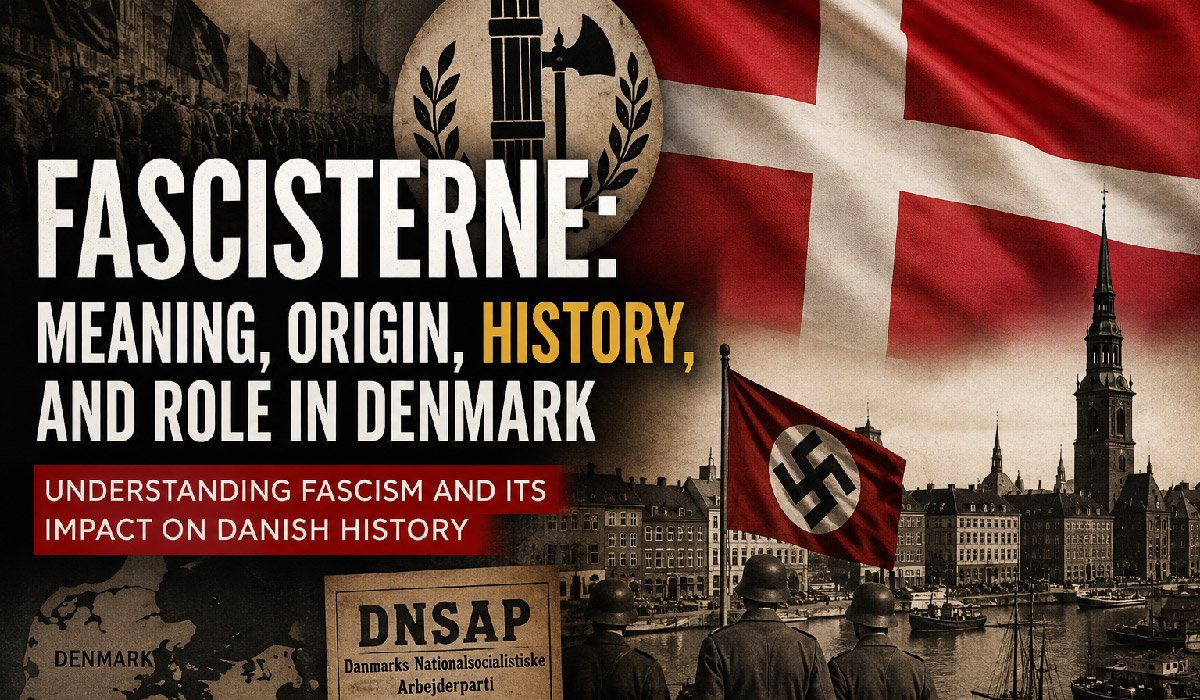
Fascisterne is a Danish term closely connected with fascism, European politics, and twentieth-century history. In English, it means “the fascists,” referring to people or groups associated with fascist political beliefs and movements.
The term became especially important because fascist movements influenced several European countries before and during World War II. In Denmark, Fascisterne also carries historical meaning connected with occupation, collaboration, resistance, and political conflict.
This article explores the meaning of Fascisterne, its language origin, the rise of fascism, its main characteristics, important leaders, Denmark’s experience, World War II, DNSAP, and the ideology’s lasting historical impact.
What Is Fascisterne?
Fascisterne is the definite plural form of the Danish word fascist. The simplest English translation is “the fascists.” It normally describes a particular group of people associated with fascist ideas, organizations, or political movements.
The term is connected with fascisme, the Danish word for fascism. Fascism developed as an authoritarian political ideology that placed strong emphasis on nationalism, centralized leadership, national unity, and the power of the state.
Fascisterne is therefore not simply a misspelling or random internet term. It is a real Danish word. Its exact meaning can depend on context, particularly when it appears in Danish history, World War II discussions, or modern politics.
Why Is Fascisterne a Known Term?
Fascisterne attracts attention because readers may encounter the word without knowing it is Danish. Its spelling looks unusual to English speakers, making its meaning difficult to understand without translation and historical context.
The word is strongly connected with one of Europe’s most important political periods. Fascist movements expanded during the early twentieth century, while authoritarian governments in Italy and Germany played major roles in events surrounding World War II.
For Danish readers, the term can have an additional historical connection. Discussions about Denmark under German occupation, Danish fascist organizations, collaborators, resistance groups, and Nazi influence can all involve references to fascists and fascist politics.
Is Fascisterne a Misspelling or Short Form?
Fascisterne may look like a misspelled version of “fascist” or “fascism” to an English-speaking reader. However, it is actually a Danish word with its own grammatical form and meaning.
The ending helps give the term its specific Danish meaning. Instead of simply describing fascists generally, Fascisterne can be translated as “the fascists,” referring to an identified or understood group within a particular discussion.
It is also not a short form for another political organization. Confusion mainly comes from language differences. Once its Danish origin is understood, the relationship between Fascisterne, fascists, and fascism becomes much clearer.
Where Does the Word Fascisterne Come From?
Fascisterne belongs to Danish political vocabulary and is built from the word fascist. Its deeper linguistic history is connected with the Italian political term fascismo, from which the English word “fascism” also developed.
Modern fascism became associated most strongly with Benito Mussolini’s political movement in Italy. The Italian movement grew after World War I and later became the model for several authoritarian nationalist movements elsewhere in Europe.
As fascism became an international political subject, related words entered different European languages. Danish developed its own forms for discussing fascism and its supporters, which explains why Fascisterne appears different from the familiar English spelling.
How Fascism Began in Europe
Fascism developed during a difficult period in European history. World War I had caused enormous human and economic damage. Political instability, unemployment, social unrest, and fear about the future affected several countries.
Italy became the birthplace of organized modern fascism. Benito Mussolini founded the Fasci di Combattimento in 1919. His movement appealed to nationalists, war veterans, and others who wanted stronger political leadership and greater national power.
Mussolini became Italian prime minister in 1922. His government gradually weakened democratic institutions and built an authoritarian system. Fascist ideas later influenced political organizations and movements in Germany and several other European countries.
Why Fascism Gained Support
Economic and political uncertainty helped fascist movements attract supporters. Many Europeans experienced unemployment, social tension, political violence, and disappointment with existing governments after World War I.
Fascist leaders presented themselves as people who could restore order and national strength. They used powerful speeches, symbols, rallies, propaganda, and nationalist messages to build support among sections of the population.
Fear also played an important role. Fascist movements strongly opposed communism and liberal democracy. They promised stability and national unity, but their rise often resulted in reduced political freedom, suppressed opposition, and concentrated government power.
Main Beliefs Behind Fascism
Extreme nationalism was one of fascism’s most important characteristics. The interests of the nation were placed above individual interests. Citizens were expected to show strong loyalty to the country and its political leadership.
Authoritarian government was another central feature. Political authority was concentrated around a powerful leader or ruling party. Democratic competition, independent political organizations, and opposition movements were often restricted or completely removed.
Fascist movements also valued discipline, military strength, national unity, and state authority. Propaganda was widely used to influence society, while critics, political rivals, journalists, and groups considered enemies could face censorship, intimidation, imprisonment, or violence.
Nationalism and Strong Leadership
Fascist ideology promoted an intense form of nationalism. Supporters believed that a strong and united nation should take priority over personal freedom, political disagreement, and competing social interests.
The leader was often presented as a symbol of national strength. Political systems became highly centralized, allowing one leader or party to make major decisions without the normal limits found in democratic governments.
This leadership model reduced political accountability. Opposition could be treated as disloyalty rather than normal democratic disagreement. As power became concentrated, governments gained greater control over political institutions, communication, education, and public life.
Propaganda and Control of Society
Propaganda became a powerful instrument under fascist governments. Leaders understood that controlling information could influence how citizens viewed the government, its enemies, and the future of their country.
Newspapers, radio, posters, speeches, public ceremonies, rallies, and political symbols helped spread official messages. Governments could present leaders as national heroes while encouraging citizens to support state policies and reject opposing viewpoints.
Control extended beyond political messaging. Education, cultural activities, youth organizations, and public institutions could also promote government-approved ideas. This allowed authoritarian governments to influence both political behavior and everyday social attitudes.
Fascism and Political Opposition
Fascist governments generally rejected open political competition. Independent parties and organizations could challenge centralized authority, so opposition groups often became targets once fascist leaders gained control.
Censorship limited criticism from newspapers, writers, activists, and other public voices. Political opponents could face threats, arrest, imprisonment, or violence. Independent organizations were sometimes closed or placed under government control.
These practices separated fascist rule from democratic government. Democracy depends on political competition and peaceful disagreement, while fascist systems concentrated authority and treated organized opposition as a threat to national unity and state power.
Fascism, Race, and Minority Groups
Some fascist movements promoted ideas of racial, ethnic, or national superiority. Certain communities were presented as outsiders or blamed for political, economic, and social problems affecting the country.
This process created dangerous divisions. Governments and political movements could use prejudice to build support by creating a common enemy. Discrimination could then develop into legal restrictions, persecution, forced displacement, imprisonment, or violence.
Nazi Germany represented the most extreme and destructive example. Its racial ideology and antisemitism led to systematic persecution and mass murder, including the Holocaust, making this period one of history’s clearest warnings about state-driven hatred.
Benito Mussolini and the Rise of Italian Fascism
Benito Mussolini is the political figure most closely associated with the creation of modern fascism. He built a nationalist movement in Italy during the unstable years following World War I.
After becoming prime minister in 1922, Mussolini gradually increased his control. Democratic freedoms weakened as his government developed into a dictatorship. Political opponents faced pressure while state propaganda strengthened his public image and authority.
Mussolini’s government became an important example for other European movements. His emphasis on nationalism, centralized power, authoritarian leadership, and state authority helped establish political methods later associated with fascist governments elsewhere.
Adolf Hitler and Nazism
Adolf Hitler became Germany’s most infamous authoritarian leader after the Nazi Party rose to power. His government shared several characteristics with fascist Italy, including extreme nationalism, dictatorship, militarism, propaganda, and suppression of political opposition.
However, Nazism developed its own especially extreme racial ideology. Antisemitism and beliefs about racial hierarchy became central parts of Nazi policy. These ideas resulted in widespread persecution and eventually systematic mass murder.
Hitler’s expansionist policies also contributed directly to World War II in Europe. Nazi Germany’s actions brought enormous destruction, displacement, persecution, and death, leaving consequences that continue to shape historical study and remembrance.
Giovanni Gentile and Fascist Thought
Giovanni Gentile was an Italian philosopher associated with the intellectual development of Italian fascism. His political thinking emphasized the importance of the state over individual interests.
This idea supported the fascist belief that citizens should find their political identity through the nation and state. Individual freedom was therefore given less importance than collective national purpose and government authority.
Gentile’s ideas helped provide an intellectual framework for Mussolini’s political system. While fascism developed through many political and social forces, his work became closely connected with attempts to explain and justify Italian fascist ideology.
Fascisterne in Denmark
Fascisterne has special historical importance in Denmark because Danish society also experienced fascist political activity. Denmark never developed a fascist government comparable to Mussolini’s Italy or Hitler’s Germany.
However, fascist and National Socialist political movements did exist in the country. The best-known was Danmarks Nationalsocialistiske Arbejderparti, commonly shortened to DNSAP, which followed ideas strongly influenced by Nazi Germany.
The party gained some supporters but remained politically limited. It was unable to win enough electoral support to take control of Denmark, meaning Danish fascism never achieved the governmental power seen in Germany or Italy.
What Was DNSAP?
Danmarks Nationalsocialistiske Arbejderparti was Denmark’s best-known National Socialist political party. Its name can be translated as the National Socialist Workers’ Party of Denmark.
Frits Clausen became its most recognizable leader. The movement was heavily influenced by German National Socialism and promoted political ideas similar to those associated with Hitler’s Nazi movement.
Despite its activities, DNSAP failed to become a dominant Danish political force. Its limited electoral success is important when understanding Fascisterne in Denmark because the presence of fascist movements did not mean most Danish citizens supported them.
Denmark During the German Occupation
Germany invaded Denmark on 9 April 1940. The invasion brought Denmark directly into the European conflict and began an occupation that continued until Germany’s defeat in 1945.
During occupation, Danish society faced difficult political and social conditions. Questions involving cooperation, resistance, German authority, and Danish supporters of National Socialism became increasingly important as the war continued.
This period gives Fascisterne a particularly strong historical context in Denmark. The word may appear when discussing fascist supporters, Nazi-aligned political organizations, collaborators, or broader political forces connected with occupation-era history.
Danish Resistance Against the Occupation
Not everyone accepted German occupation or fascist influence. Danish resistance groups became increasingly active and worked against German control in different ways during the war.
Resistance activities included sabotage, intelligence gathering, underground communication, and illegal newspapers. Networks also helped people escape danger. These activities became an important part of Denmark’s wartime history and its response to occupation.
Resistance involved serious risks because participants could face arrest and punishment. Over time, the resistance movement became an important symbol of opposition to Nazi Germany and the political system represented by the occupying power.
The Rescue of Danish Jews
One of the most remembered events in Danish wartime history occurred in October 1943. A major effort developed to protect Denmark’s Jewish population from Nazi persecution and deportation.
Resistance members and ordinary Danish citizens helped thousands of Jewish people reach Sweden, which remained neutral during the war. Boats were used to transport many people across the water to safety.
The operation successfully helped most Danish Jews escape the immediate threat of Nazi deportation. Today, the rescue is remembered as an important humanitarian chapter within the much larger and tragic history of the Holocaust.
Fascism and Nazism: Are They the Same?
Fascism and Nazism are closely related, but the words should not always be treated as exact synonyms. Fascism is the broader political category that developed first in Mussolini’s Italy.
Nazism refers specifically to National Socialism as developed by Adolf Hitler and Germany’s Nazi Party. It shared authoritarian leadership, extreme nationalism, militarism, propaganda, and opposition to democratic political competition with other fascist movements.
Nazism also placed particularly strong emphasis on racial hierarchy and antisemitism. For this reason, Nazism is generally understood as a specific and especially destructive form of fascism rather than simply another name for every fascist movement.
Fascisterne vs Nazisterne
Understanding the Danish words helps prevent another common misunderstanding. Fascisterne means “the fascists,” while Nazisterne means “the Nazis.” Their meanings overlap historically, but they are not completely interchangeable.
Fascisterne can describe supporters of fascist ideology more broadly. This can include movements outside Nazi Germany and people connected with different forms of historical fascism.
Nazisterne has a narrower meaning because it refers specifically to Nazis or National Socialists. Therefore, all historical Nazis can be discussed within the broader study of fascism, while not every fascist movement was Nazi.
Fascism Compared With Communism
Fascism and communism are different political ideologies even though authoritarian governments associated with both have concentrated significant political power. Their basic political and economic ideas are not the same.
Communist theory focuses strongly on class, collective ownership, and eliminating major economic divisions between social classes. Fascist ideology instead emphasizes nationalism, national unity, hierarchy, authoritarian leadership, and the interests of the state.
The historical systems also developed differently across countries. Comparing them requires attention to their individual beliefs and histories rather than treating every government with strong centralized authority as the same political ideology.
The Role of Militarism in Fascism
Military values were important to many fascist movements. Discipline, physical strength, sacrifice, obedience, and national power were often presented as positive qualities that citizens should respect.
Strong armed forces could also support wider political goals. Expansion of national territory and military achievement were sometimes portrayed as signs that a country was becoming powerful and respected again.
This combination of nationalism and militarism contributed to international tension during the twentieth century. In Nazi Germany and fascist Italy, aggressive foreign policies eventually became closely connected with wider European warfare and destruction.
What Happened to Fascisterne After World War II?
World War II ended in Europe in 1945 with the defeat of Nazi Germany and its allies. The political environment that had allowed powerful fascist governments to dominate parts of Europe changed dramatically.
Major fascist governments collapsed, and organizations connected with defeated regimes lost power. Countries affected by occupation also dealt with individuals who had cooperated with occupying forces or supported enemy governments.
Denmark similarly faced the difficult issue of wartime collaboration. After liberation, collaborators were investigated and prosecuted under the postwar legal process, while organized fascist politics lost much of the influence it had held during the wartime period.
The Lasting Impact of Fascism
Fascist governments left Europe with enormous political, social, and human damage. Dictatorship had weakened democratic institutions while censorship and persecution had removed basic freedoms from millions of people.
World War II created destruction on an extraordinary scale. Communities were displaced, cities were damaged, and millions died through warfare, persecution, imprisonment, forced labor, genocide, and other forms of violence.
The experience influenced postwar thinking about democracy and human rights. Historical research, museums, memorials, education, and remembrance programs continue to preserve knowledge about fascism, Nazism, occupation, resistance, war, and the Holocaust.
How Fascisterne Is Used Today
Today, Fascisterne can still appear in Danish historical writing, books, educational material, political discussions, and conversations about extremist political movements. Its intended meaning depends heavily on context.
When discussing history, the term can have a fairly specific meaning and describe people or groups associated with fascist ideology. Danish World War II discussions may give it an even more specific historical setting.
Modern political debate is more complicated. People sometimes apply words such as “fascist” to opponents without using the historical definition carefully. Understanding the original ideology therefore helps readers separate historical fascism from general political criticism.
Why Understanding Fascisterne Matters
Learning about Fascisterne involves more than translating one Danish word. The term opens a much larger subject involving nationalism, dictatorship, propaganda, political violence, World War II, occupation, resistance, and European history.
It is particularly useful for understanding Denmark’s experience. Fascist movements existed in Denmark, but they never gained enough electoral support to establish a fascist Danish government. German occupation created a different and more difficult political situation.
Understanding this history also makes modern use of the term easier to evaluate. Knowing what historical fascism actually involved allows readers to recognize why the word carries such serious political and historical meaning.
Final Thoughts
Fascisterne is a real Danish word meaning “the fascists.” It is neither simply a misspelling nor an internet-created short form. Its meaning comes from Danish language and the wider history of fascism.
The term connects directly with the rise of fascist movements in twentieth-century Europe. Mussolini’s Italy, Hitler’s Germany, World War II, Danish fascist organizations, occupation, resistance, and the rescue of Danish Jews all provide important historical context.
Today, Fascisterne remains useful when studying European and Danish political history. Understanding both its direct translation and historical background gives readers a much clearer picture of what the term actually represents.
FAQs
What does Fascisterne mean in English?
Fascisterne is a Danish word that translates to “the fascists” in English. It normally refers to a particular group of people associated with fascist political ideas, organizations, movements, or historical regimes.
Is Fascisterne a misspelling of fascism?
No. Fascisterne may look unusual to English readers, but it is a real Danish word. It means “the fascists,” while fascism refers to the broader political ideology associated with fascist movements.
Is Fascisterne the same as Nazisterne?
Not exactly. Fascisterne means “the fascists,” while Nazisterne means “the Nazis.” Nazism shares major characteristics with fascism but refers specifically to National Socialism associated with Adolf Hitler and Nazi Germany.
Did Denmark have a fascist government?
Denmark did not develop a fascist government like Italy or Nazi Germany. However, fascist and National Socialist groups existed, including DNSAP, which was led by Frits Clausen and influenced by German National Socialism.
Who is considered the founder of fascism?
Benito Mussolini is most closely associated with the founding of modern fascism in Italy. He established the Fasci di Combattimento in 1919 and became Italian prime minister in 1922.
Latest News And Amazing News. Visit: Insider Zine