

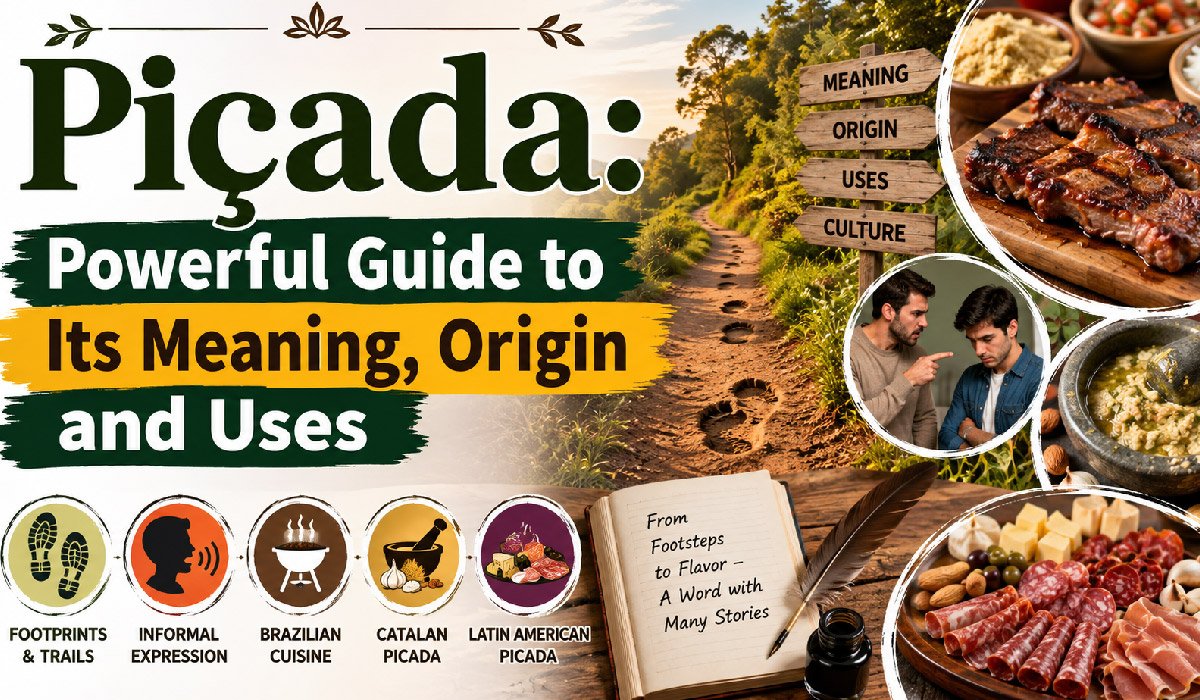
Piçada is a term that can create confusion because its meaning changes according to spelling, language, region, and context. A reader may find Piçada in Portuguese-related content, while the similar-looking word Picada appears widely in Spanish, Catalan, and Latin American food culture. Although these forms may look closely connected, they should not automatically be given the same definition.
Understanding Piçada therefore requires more than translating one word into English. The surrounding sentence, country, subject, and local language all provide important clues. A word connected with rural life may have a very different meaning from one appearing in a food article or informal conversation.
This guide explains Piçada meaning, possible linguistic connections, pronunciation, regional interpretations, culinary associations, and the important difference between Piçada and Picada. It also shows how context can help readers avoid common translation mistakes.
What Is Piçada?
Piçada can be understood as a context-dependent term associated with Portuguese-language usage, but it does not have one simple meaning that can safely be applied everywhere. Different online sources connect it with ideas such as a mark made by stepping, a track or pathway, informal speech, and regional cultural uses. Some of this confusion also comes from mixing Piçada with the much more familiar word Picada.
The best way to understand Piçada is to look at where it appears. Country and subject matter are especially important. A word used in a rural description may relate to movement across land, while a similar spelling on a menu may have a completely different background.
Readers should therefore avoid treating every definition found online as universal Portuguese. Regional language changes considerably, particularly across the Portuguese-speaking world, and similar spellings can sometimes represent separate linguistic histories.
Piçada Meaning in Simple Words
In simple terms, Piçada may describe an idea connected with stepping, a mark, movement, or a regional expression, depending on the source and location. However, there is no reason to assume that every Portuguese speaker uses the term in exactly the same way. Local vocabulary and informal language can differ significantly between communities.
The surrounding words usually reveal more than the term alone. If Piçada appears beside references to soil, walking, countryside, or tracks, the intended meaning may concern a physical mark or pathway. When it appears in conversation, the meaning may instead depend on local slang and the speaker’s tone.
Food creates additional confusion because the spelling Picada is used for established culinary concepts in several regions. For this reason, readers should first check the exact spelling before deciding what Piçada means in a particular sentence.
Origin and Linguistic Background of Piçada
Explaining the origin of Piçada requires care because similar Romance-language words can easily become mixed together. Portuguese developed from Latin and shares a large amount of vocabulary and grammatical history with Spanish, Catalan, Galician, and other Romance languages. Similar-looking words are therefore common, but similarity does not always prove that their modern meanings are identical.
Some explanations associate Piçada with ideas involving stepping or treading. Portuguese pisar means to step or tread, which helps explain why step-related interpretations may appear in discussions of the term. Other explanations confuse these associations with words derived from picar, a verb carrying meanings connected with actions such as pricking or chopping.
These possible connections should not be combined without context. Etymology depends on the actual word form and historical development. A modern regional spelling, informal expression, and established culinary term can each have a different linguistic story.
Piçada vs Picada: What Is the Difference?
Piçada and Picada look very similar, but changing a single letter matters. Picada is an established word in several languages and regions. Depending on the language, it can refer to something chopped, a bite or sting, a pathway, a culinary preparation, or a platter of food. Its precise definition still depends on where and how it is used.
Piçada contains a cedilla under the letter c. This makes it visually distinct and also raises an important Portuguese spelling issue. In Portuguese, the cedilla is used to give the letter c an “s” sound before certain vowels. It is not simply decorative punctuation that can be added to any word.
For readers researching Piçada online, the safest approach is to preserve the spelling found in the original source. Searching Picada separately is also useful because search engines may combine results for terms that look similar even when their linguistic backgrounds differ.
Understanding the Cedilla in Piçada
The symbol beneath the “ç” is called a cedilla. In Portuguese, it changes the sound of the letter c. Without a cedilla, a c before “a,” “o,” or “u” normally has a hard sound similar to the c in “cat.” Adding the cedilla produces a soft sound similar to an English “s.”
This rule explains familiar Portuguese words such as açúcar, meaning sugar, and coração, meaning heart. The cedilla therefore carries real pronunciation and spelling importance. At the same time, the presence of ç does not by itself prove the origin or definition of an unfamiliar term.
This distinction matters particularly for Piçada. Readers sometimes assume that Piçada is merely another spelling of Picada. That conclusion may be too simple. When researching the term, both spelling and original language should be checked before borrowing definitions from Spanish, Catalan, or another regional tradition.
Piçada and the Idea of Footprints or Tracks
One interpretation associated with Piçada concerns the mark created when a person or animal steps on a surface. Footprints can remain clearly visible in mud, loose soil, sand, or other soft ground. In rural settings, these marks may provide useful information about movement through an area.
Tracks have long played an important role in countryside life. Farmers can observe animal movement, while people traveling through forests may recognize signs of repeated passage. When many people or animals repeatedly use the same route, a visible track can gradually develop through vegetation or across open ground.
This helps explain why vocabulary involving footsteps can become connected with paths and trails. However, regional terminology varies considerably. Readers should not assume that Piçada is the standard Portuguese word for every footprint or path. Its meaning should be confirmed from the particular regional context in which it appears.
Piçada as a Rural Path or Trail
A trail does not always begin as a formally constructed road. In forests, fields, and farming areas, repeated movement can gradually flatten plants and compact the soil. Over time, the same route becomes easier to recognize and follow. Words associated with stepping can naturally develop meanings connected with these visible routes.
This interpretation gives Piçada an interesting connection with rural landscapes. A path may show where people regularly travel between homes, farms, fields, water sources, or other locations. Animal movement can create similar tracks. Such routes can exist without signs, paving, or official names.
Regional vocabulary is especially important here. Portuguese is spoken across different countries and communities, and local expressions do not always appear in standard dictionaries. When Piçada occurs in a description of countryside movement, readers should examine the complete passage rather than translating the word independently from its surroundings.
Piçada in Portugal and Informal Speech
Online explanations sometimes connect Piçada with informal Portuguese speech and the idea of receiving a strong correction or reprimand. Informal expressions can develop meanings that differ considerably from their literal roots. Tone of voice, relationship between speakers, and regional habits may all affect how such an expression is understood.
This type of usage needs particular caution. Slang is rarely uniform across an entire country. An expression familiar within one generation, town, profession, or social group may sound unusual to other native speakers. Internet articles can sometimes make a limited regional expression appear much more widespread than it really is.
For that reason, Piçada should not automatically be presented as the universal Portuguese term for a reprimand. When the word appears in dialogue, readers should consider who is speaking and where the conversation occurs. Local context is more reliable than assuming one informal definition applies throughout Portugal.
Piçada in Brazil and Regional Language
Brazil contains enormous linguistic diversity. Brazilian Portuguese includes vocabulary influenced by geography, migration, Indigenous languages, African languages, immigration, and centuries of local cultural development. A word heard in one Brazilian state may be uncommon or carry another meaning somewhere else in the country.
This diversity is important when researching Piçada. Some online descriptions associate the term with Brazilian countryside language, trails, food, or other regional traditions. Such claims need to be understood locally rather than presented as standard Brazilian Portuguese. Minas Gerais, Bahia, Rio Grande do Sul, São Paulo, and other regions all have their own linguistic and culinary traditions.
Context therefore remains essential. If Piçada appears in Brazilian writing, readers should identify the region and subject before deciding what it means. Local expressions are valuable parts of language, but their existence does not necessarily mean that millions of Portuguese speakers elsewhere use the word in the same way.
Piçada and Brazilian Food Culture
Piçada is also sometimes described online in connection with regional Brazilian food, particularly meat-based meals and social gatherings. Brazilian cuisine certainly has strong traditions of preparing pork, beef, sausages, and other foods for groups of family members and friends. Grilling and shared dishes form important parts of social life in many regions.
However, culinary terminology can become especially confusing when Piçada is mixed with Picada. The latter spelling has recognized food-related meanings in Spanish-speaking cultures, while individual Brazilian communities may use their own regional names for dishes, portions, or methods of preparation. A menu or local recipe therefore provides stronger evidence about meaning than spelling alone.
When Piçada appears as the name of a food, readers should examine the location, ingredients, and restaurant or family tradition involved. This prevents a highly local dish name from being incorrectly described as a standard food throughout Brazil.
Picada in Catalan Cooking
Catalan picada is a useful example of why Piçada and Picada must be separated carefully. In Catalan cuisine, a picada is a preparation traditionally used to add flavor, body, and character to dishes. Ingredients can vary, but combinations may include nuts, garlic, bread, herbs, or other components that are crushed or ground together.
Rather than necessarily being eaten as an independent meal, the mixture can be incorporated into a dish during cooking. Its exact ingredients vary by recipe and family tradition. This culinary practice has a long connection with Catalan cooking and demonstrates how one word can acquire a highly specific meaning within a particular food culture.
Calling Catalan picada “Piçada” would blur an important spelling and cultural distinction. When discussing the Catalan preparation, Picada is the appropriate form. Its existence helps explain some search-result confusion, but it should not automatically define the Portuguese-looking term Piçada.
Picada in Argentina and Latin America
Picada carries another familiar culinary meaning in Argentina, where it commonly describes a selection of small foods shared socially. A picada may contain cheese, cured meats, olives, bread, nuts, or other snacks. The exact combination changes according to personal preference, occasion, and local tradition.
The social element is just as important as the ingredients. People can place the food in the center of a table and eat while talking, relaxing, or spending time together. Related uses and variations also appear elsewhere in Latin America, although local definitions and ingredients are not necessarily identical from country to country.
This meaning should again be distinguished from Piçada. Similar-looking terms often appear together in search results, encouraging readers to merge their definitions. Identifying the language first solves much of the confusion. Argentine Picada belongs to a Spanish-speaking culinary context and should be explained on those terms.
Cultural Meaning and Symbolism
Words associated with footsteps, paths, and marks can develop strong figurative meanings. A footprint is not only a physical impression on the ground. In literature and everyday metaphor, it can represent the influence someone leaves behind. A path can similarly represent personal development, travel, history, or movement from one stage of life to another.
These symbolic ideas can help explain why step-related vocabulary is flexible. Rural communities also preserve knowledge through routes, landscapes, oral descriptions, and local terminology. Food adds another form of cultural memory because recipes and shared meals can pass from one generation to the next.
Still, symbolism should not be mistaken for dictionary meaning. Saying that Piçada can evoke ideas of traces, journeys, or community does not prove that all of these are formal definitions. Cultural interpretation works best when it supports, rather than replaces, accurate linguistic context.
Piçada in Modern Online Usage
Digital communication allows uncommon words to travel much farther than they once did. Piçada may now appear in search results, blogs, social posts, travel writing, menus, language discussions, and automatically translated pages. Someone encountering the term online may therefore have no information about the original speaker or regional setting.
Search technology can make the situation more complicated. A spelling correction may redirect Piçada toward Picada, while copied articles can repeat definitions without explaining their linguistic source. Automatic translation may also choose the most common related term rather than preserving a rare or regional meaning.
Readers should therefore check the original context whenever possible. Look at the language of the page, the country being discussed, and the topic surrounding the word. These clues often provide a clearer answer than a definition copied from an unrelated source. Modern usage makes Piçada easier to discover but not necessarily easier to interpret.
Common Misunderstandings About Piçada
The biggest misunderstanding is the belief that Piçada has one fixed definition across Portuguese, Spanish, Catalan, and Latin American cultures. Languages do not work that way. Similar spelling may result from related linguistic history, regional development, transcription differences, or simple online confusion. Meaning must be established from actual usage.
Another common mistake is treating Piçada and Picada as interchangeable. Picada has several well-established meanings of its own, including important culinary uses. Adding a cedilla creates a different written form and raises questions about Portuguese spelling and pronunciation that should not be ignored.
Readers may also assume that a regional Brazilian or Portuguese expression is used throughout the entire Portuguese-speaking world. This can produce misleading explanations. A more accurate approach identifies the language, country, region, spelling, and topic first. Those details provide the strongest clues to the intended meaning.
How to Understand and Use Piçada Correctly
The easiest way to understand Piçada is to read beyond the word itself. Start with the complete sentence. A discussion involving footprints, soil, forests, or walking suggests a very different interpretation from a menu, recipe, or conversation about someone’s behavior. The country of origin provides another important clue.
Spelling should then be checked carefully. If the original source actually says Picada, definitions belonging to Spanish or Catalan may become relevant. If it specifically says Piçada, changing the spelling without evidence can remove useful information about the source or intended pronunciation. Regional expressions may require additional local context.
When using Piçada in your own writing, explain what you mean instead of assuming every reader knows the term. This is particularly useful in English-language content. A short contextual explanation keeps the writing clear while respecting differences between languages and regional traditions.
Why Piçada Is an Interesting Language Example
Piçada shows why language cannot always be understood through direct translation. Portuguese, Spanish, and Catalan developed within the Romance language family, so they naturally contain words that resemble one another. Centuries of migration, trade, regional identity, and cultural exchange have added even more variation to how related terms are used.
The topic also demonstrates the importance of polysemy, where a word or closely related form can develop several meanings. Physical actions can inspire figurative expressions, while ordinary verbs can influence the names of foods, objects, and activities. Geography then adds another layer as communities develop their own vocabulary.
For language learners, Piçada is therefore useful as a case study in context. Instead of matching one unfamiliar spelling with the first translation available, readers learn to consider pronunciation, regional usage, etymology, and subject matter together. That approach produces a more accurate understanding of unfamiliar vocabulary.
Final Thoughts
Piçada is an interesting term precisely because it cannot be explained responsibly with one short translation. Depending on the source, it may be associated with stepping, tracks, rural paths, informal regional language, or locally described cultural uses. At the same time, much online confusion comes from the visually similar but distinct word Picada.
Understanding the difference requires attention to spelling, pronunciation, country, and context. The cedilla has a genuine function in Portuguese, while Picada has established meanings in Catalan and Spanish-speaking cultures, including well-known culinary traditions. Regional Portuguese and Brazilian expressions also deserve to be identified as regional rather than universal.
For readers who encounter Piçada online, context remains the most useful guide. Checking the original sentence and language can prevent misleading translations. More broadly, the term demonstrates how closely language, geography, food, history, and everyday culture can interact across different communities.
FAQs
What does Piçada mean?
Piçada is a context-dependent term associated with different regional meanings. It may relate to stepping, tracks, rural paths, or local expressions. Its exact meaning depends on the language, location, spelling, and surrounding context.
What is the origin of Piçada?
Piçada is discussed in connection with Portuguese linguistic roots and ideas involving stepping or treading. However, its origin should be interpreted carefully because it is often confused online with the separate word Picada.
What is the difference between Piçada and Picada?
Piçada contains the Portuguese letter “ç,” while Picada does not. Picada has established meanings in Spanish and Catalan, including culinary uses. The two spellings should not automatically be treated as interchangeable.
Is Piçada used for food?
Some online and regional sources connect Piçada with food traditions. However, many well-known culinary meanings actually belong to Picada, such as Catalan picada and the shared food platters commonly found in Argentina.
How do I know what Piçada means in a sentence?
Check the country, language, spelling, and surrounding words. References to walking or land may suggest a track-related meaning, while menus and recipes may indicate a culinary context. Regional usage should also be considered.
Latest News And Amazing News. Visit: Insider Zine